

When talking about China today, it’s hard to avoid superlatives. Scarcely a week passes without headlines about new AI models, humanoid robots, or billion-dollar subsidies. It’s easy to get the impression that China has long since left Europe in the dust when it comes to software and AI.
During my sabbatical, I wanted to put this theory to the test. Over the past few weeks, I visited numerous AI and robotics startups, talked with engineers, toured industrial companies, and spent a day at the World AI Conference (WAIC) in Shanghai—one of the largest AI trade shows in the world.
My most important takeaway from all these insights can be summed up in a single sentence:
China isn’t winning because its software is better. China is winning through extreme execution speed, scaling, and a fundamentally different understanding of where value is created.
1. Mechanically Brilliant, Mentally Limited: The True State of Robotics
First of all: I am talking here about humanoid or autonomous robots controlled by AI. I am not talking about classic industrial robots, a field where China is extremely advanced.
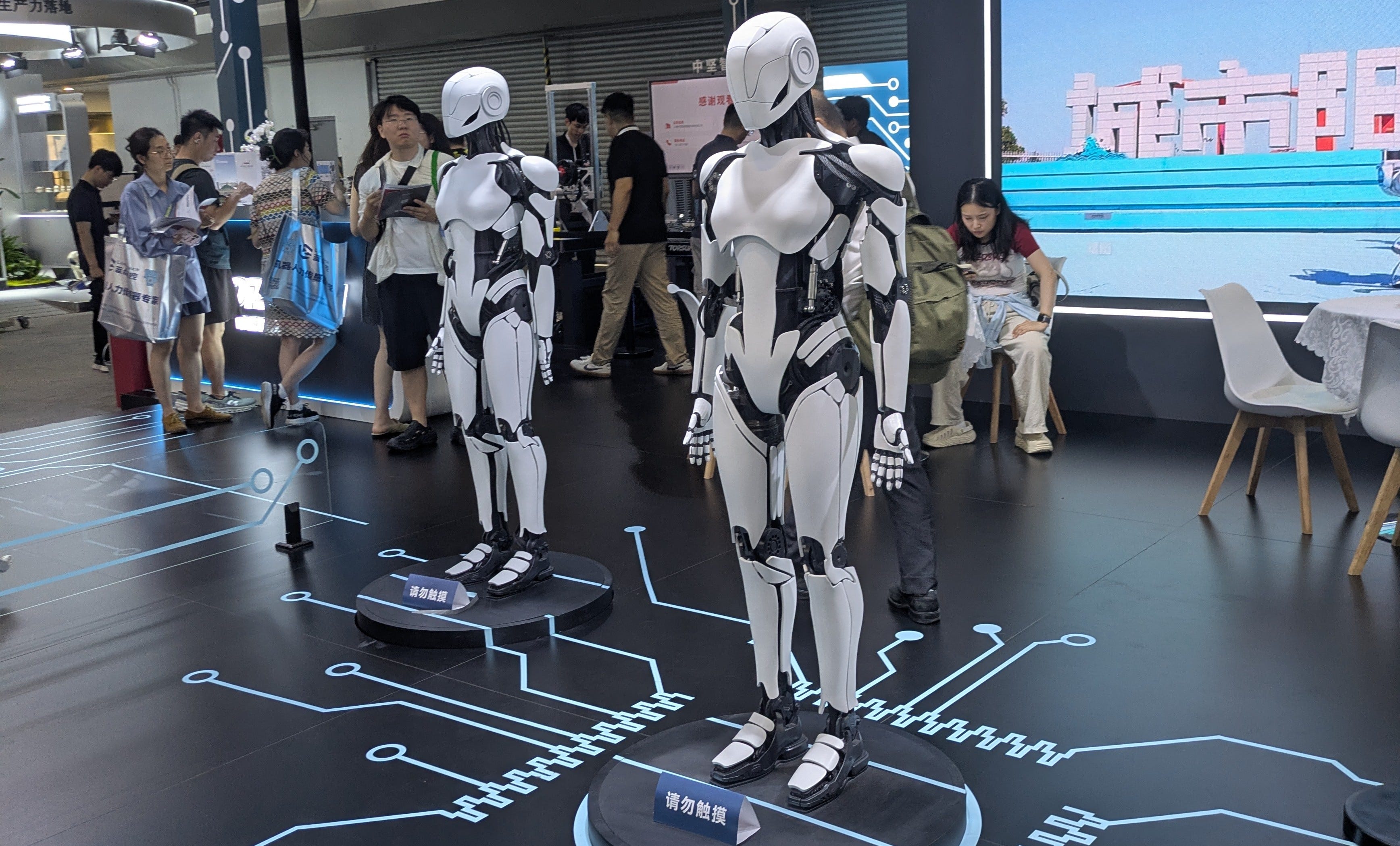
The WAIC in Shanghai is a massive showcase. Hundreds of humanoid robots lined the halls—featuring two arms, cameras, legs, or wheeled chassis. But the closer you look, the clearer the gap between show and reality becomes.
Many of these robots weren’t performing any tasks at all at the expo. Others failed at simple maneuvers like packaging a mobile phone. Ironically, the most convincing demos came from companies with Western roots (like Agile Robots). My subsequent company visits to Fourier Robotics and Agibot confirmed this impression:
The hardware is impressive: Almost every company develops its own joints, motors, and controllers in-house to radically cut costs (these components often make up 40% of the total price).
The intelligence lags behind: The control systems are mostly based on familiar NVIDIA Jetson computers, combined with standard open-source models and fine-tuning. Realistic, fully autonomous industrial applications are still a long way off.
Engineers openly admitted to me that current expectations are massively overblown. The right AI algorithms are simply lacking. Most robotics manufacturers today are building cutting-edge hardware and “waiting” for big tech players to release the “brain”—the universal AI model for robotics. According to my conversation partners, it could be up to 10 years before robots can work truly flexibly and intelligently without needing weeks of programming for a simple task.
2. Nobody Pays for Software in China
Of course, this statement is a bit of a generalization, but it’s something I effectively heard from multiple people in the industrial sector.
A key experience for me was visiting a sensor manufacturer in Vision Valley in Wuhan. The hardware was flawlessly crafted and reflected an extremely capable supply chain.
As a software developer, I naturally took a look at the control software: It worked reliably but was written in C++ with MFC—a technology we used in Switzerland 20 years ago. The user interface also looked like a relic from the 90s.
The customers don’t seem to care much. And this highlights a deep-seated cultural pattern: In China, software is not valued as a standalone product that you pay for.
Software is seen primarily as a means to an end—as the lubricant to sell hardware. While we in Europe invest a lot of time in software architecture, clean code, frameworks, and elegant UX, in China, one question matters above all: Does the product solve the customer’s specific problem here and now? If yes, it sells. Everything else can be patched later.
The consequence for us: Don’t try to go to China to sell pure software or differentiate yourself through refined software architecture. Chinese customers usually expect software as a free side dish to the hardware.
3. The Open-Source Strategy: An Attack on Western Business Models
This view of software also explains a strategic dynamic that is often overlooked in Europe: China’s massive involvement in open-source software.
Backed by tech giants and the state, Chinese companies are flooding the market with freely accessible AI models and developer platforms (as Agibot does with robotics software, for example). This doesn’t seem to me like pure charity, but rather a ruthless industrial policy strategy:
Software becomes a free commodity: Proprietary software and licensing models from Western providers are undermined.
Value creation shifts: If the “brain” (software) is free, the profit margin migrates to where the “body” and the “nervous system” are built—meaning hardware, data centers, chips, and energy supply. Exactly where China has its greatest industrial economies of scale.
At the same time, China relies on sheer volume: Hundreds of startups are testing the same use cases in parallel. Most will fail. Yet, out of this gigantic and highly inefficient ecosystem, extremely competitive components and products and an effective ecosystem ultimately emerge. At least in the areas deemed important by the Chinese leadership.
4. The Opportunity for Europe: The Bridge to the Global Market
So, does this Chinese dynamic threaten the Swiss software industry? My answer is: No—on the contrary, it creates a massive opportunity.
Chinese companies are outstanding at bringing functional hardware to market extremely quickly and cheaply. But when these products leave their domestic market to be sold in the West (in Europe or the US), they quickly hit a wall:
Western industrial customers will not accept outdated C++ interfaces or poor UX.
Requirements for cybersecurity, supply chain security, data privacy (GDPR), and enterprise system integration are exponentially higher in the West.
Trust in software security is the ultimate door-opener on a global scale.
This is exactly where our playing field lies. Chinese hardware manufacturers wanting to expand globally need Western software expertise. They need partners who can equip their cutting-edge hardware with a software layer that meets European standards for quality, security, and usability.
Conclusion: What We in Switzerland Must Do Now
We do not need to surrender to what is happening in China. When it comes to software architecture, engineering quality, systems thinking, and user-friendliness, we are still excellently positioned.
However, what we urgently need to learn from China is their mindset and speed of execution. A Chinese founder summed it up perfectly during my trip:
“Just find a problem and solve it.”
In Europe, we tend to analyze problems to death before the first line of code is even written. Or we find a brilliant solution to a problem that nobody cares about. Chinese companies bring imperfect solutions directly to the customer and let them mature on the market.
We should not make fun of imperfect Chinese code. Instead, we should combine their hardware power with our software excellence—and learn from their pragmatic forward momentum. Because true innovation doesn’t arise from the perfection of code, but rather from the place where a good idea finds the fastest route to the customer.
Infobox 1: China’s Information Security Framework
Background: Data Privacy and Cybersecurity in China
From a European perspective, it is often assumed that China has hardly any regulatory requirements regarding data privacy and cybersecurity. In reality, China has established a comprehensive legal framework in recent years, whose structure shows clear parallels to European regulations like the GDPR or the Cyber Resilience Act.
The key building blocks are:
Cybersecurity Law (CSL, 2017): The foundational law for cybersecurity and the protection of critical information infrastructure.
Data Security Law (DSL, 2021): Introduces a risk-based system for the classification and protection of data.
Personal Information Protection Law (PIPL, 2021): Regulates the protection of personal data and shares similarities with the European GDPR in many areas.
Regulations on Network Data Security Management (2024): Clarify the implementation of existing laws and specify the requirements for companies when handling data.
My Observation
Beyond the content of these laws, their practical implementation was also particularly interesting to me. Several conversation partners from international companies told me that authorities in China take a more pragmatic approach to implementing regulatory requirements than we are used to in Europe. If companies have understandable reasons for shifting priorities, coordinating with the responsible authorities seems to be possible in many cases.
This assessment is based on my on-site conversations and does not represent a universally valid statement about Chinese administrative practices.
Infobox 2: Xinchuang – China’s Path to Technological Independence
Background: Why China is Developing its Own Hardware and Software
(Note: I learned the information presented in these two infoboxes during a conversation with Amberg Technologies in Wuhan. I would like to take this opportunity to say a huge thank you to the Amberg team for the fantastic and fascinating time I was able to spend in Wuhan thanks to them!)
A central strategic goal for China is technological sovereignty. Under the term Xinchuang (信创 – Information Technology Application Innovation), the government has been pursuing the objective of gradually replacing Western IT technologies with Chinese alternatives for several years now.
The initial focus is on government authorities and state-affiliated enterprises. The strategy is often described using the so-called 2+8+N model:
2 Core Areas: Government and party organizations
8 Strategic Industries: Including finance, energy, telecommunications, and other critical infrastructures
N: Gradual expansion into other economic sectors
In the long term, the entire IT value chain is to be replaced:
Processors: For example, Kunpeng, Loongson, Hygon, or Phytium instead of Intel and AMD.
Operating Systems: Kylin, UnionTech (UOS), or OpenEuler as alternatives to Windows and macOS.
Basic Software: Chinese databases and middleware instead of Oracle or IBM.
Office Software: For example, WPS Office as an alternative to Microsoft Office.
According to my conversation partners in China, many state-owned enterprises must have largely completed their migration by the end of 2027. This transition requires significant short-term investments but serves a clear strategic goal: In the long term, China aims to become more independent from foreign key technologies and to control its own critical digital infrastructure.
Sali Reto
Danke das isch so en geile Text und ufklärig, dass ich hoffe dass es d'Adressate verstönd. Liebe Gruess Hans-Jörg
Thanks Reto for sharing these valuable insights!
I love the idea of prototyping and let the customer decide instead of overthinking a possible solution/product. We are too scared to fail and hence lose a lot of opportunities for business. I also think our customers know best what they need, so they should be included in the process of developing new products resolving their issues.
The strategy of replacing foreign tools with local solutions and the fact that Chinese hardware developers need western software expertise is effectively a huge opportunity we should not miss. This reminds me of the pattern we've already seen with solar panels and EVs: protect the domestic market first, then use scale effects to roll over the global market. Maybe something similar happens with software too.
Interesting times ahead :-)