

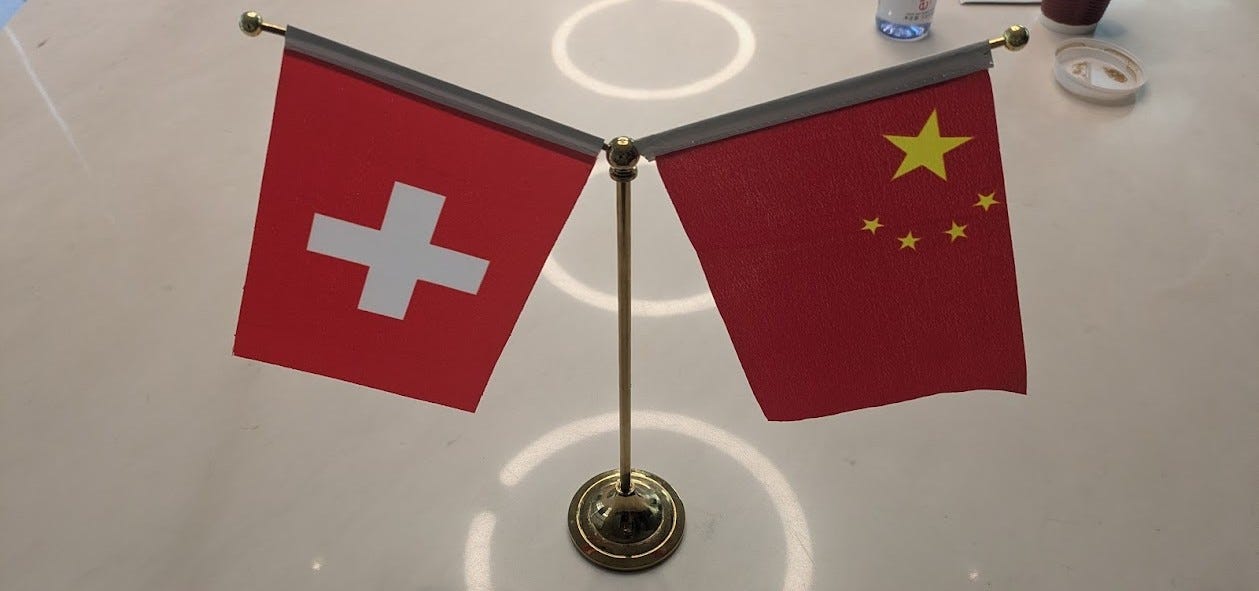
A lovely dinner with Nina Li, CFO of Homag China, left me thinking deeply about what leadership actually has to do with speed. As a subsidiary of a German mechanical engineering group in China, Homag is a fascinating hybrid of Western structure and Chinese dynamism. In this article, I share my thoughts on this and look forward to discussing them with you in the comments!
This will be a slightly longer post, as an absolute flood of thoughts went through my head on this topic that I just had to write down.
The Stereotypes
The stereotype I had in my head before my trip to China was that leadership in China is highly authoritarian and top-down. However, top-down is rather frowned upon in our modern Western society; the authoritarian leadership style carries an extremely negative connotation.
One exception we accept is the military. There, it’s clear to everyone: in an emergency, there is no time for discussion because you have to move fast.
And voilà – there we already have it, the direct connection between leadership style and speed!
Is There “Good” Top-Down Management?
I asked Nina how she leads her employees. She clearly affirmed that it is top-down management. But when she explained to me in more detail how this works in practice for her, I was very impressed by the details. Ultimately, it is reminiscent of what we understand as modern “empowerment” – but with a completely different level of consistency and clarity.
Insight 1: “Top-down doesn’t mean I don’t respect my employees”
I think that in our working environment – perhaps subconsciously – I had somehow internalized the idea that top-down management is inherently disrespectful. After thinking intensively about it, I am convinced: this connection is wrong. You can lead top-down and deeply respect your employees, and vice versa. There is simply no correlation here.
Insight 2: “Top-down means that I give my employees a lot of competence and freedom”
Here, too, I had a false connection in my head, namely between top-down and micromanagement. Obviously, you can make top-down execution extremely flexible. What Nina does brilliantly is define razor-sharp goals: what she wants to achieve through her employees’ work and by when. But crucially, she consciously does not tell them how to achieve that goal.
Insight 3: “I never do the work myself”
Nina intentionally leaves it open how employees achieve their goals. This is absolutely critical so that people can grow and learn – namely, through their own experimentation and their own mistakes. A less experienced employee might not work very efficiently at first, taking detours and making mistakes that they then have to correct themselves. For them, starting with the most efficient method right away would be too difficult because they still lack a deeper understanding. Over time, however, they learn and understand it from the ground up. If an employee asks Nina, she gives an answer on how she would do it – but she doesn’t expect them to do it exactly that way. As long as the goal is achieved, she’s happy.
Insight 4: “The team must stick together”
This is a major cultural difference between China and Europe. Every report, every book, every person I spoke with here confirms it: in Chinese culture, the collective always comes before the individual. By comparison, our culture is much more “self-centered.” The researcher Geert Hofstede has published fascinating cultural comparisons on this (if you like, you can check out other comparisons):
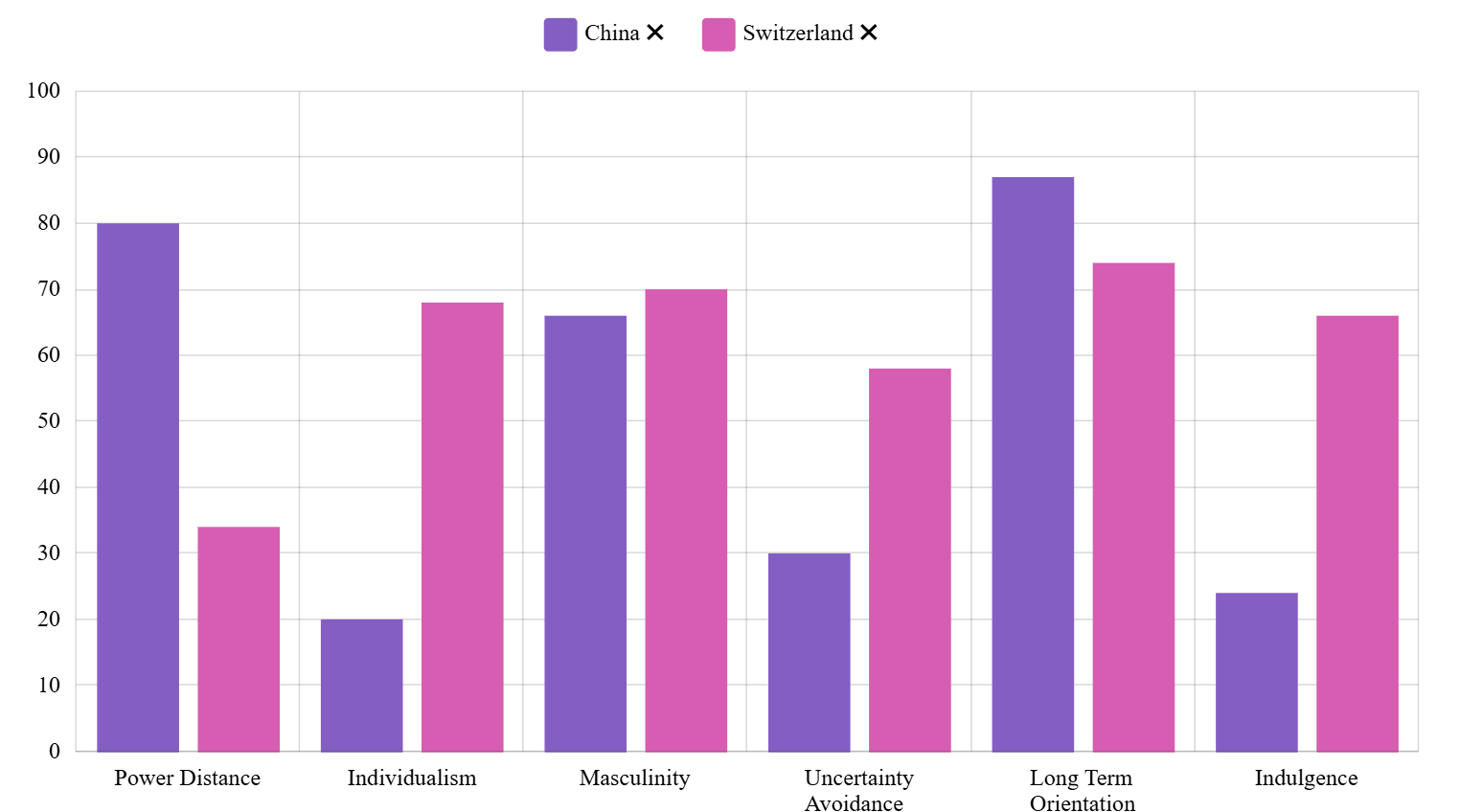
Nina fosters this team cohesion very actively. Last month for example, she rented a house, even organized childcare, and the team played and cooked together. The separation between private life and work life seems to be much less strict in China – but due to the culture, there is also less of a need for it. People are used to doing everything together and having less privacy. Personal cohesion and mutual trust are the absolute foundation – otherwise, you simply cannot work together successfully here.
Personally, I sometimes find it a pity how razor-sharp private life is separated from work life in our culture. I personally prefer teams where this boundary is more fluid. I have the feeling that the trend in Switzerland is heading rather in the opposite direction – but I hope I’m wrong about that.
Insight 5: “There are 2 reasons why someone doesn’t achieve a goal”
I have already discussed this point with several Chinese managers. When it comes to the reasons for missing goals, everyone agrees, and they are very consistent with the execution of measures:
Reason 1: Someone doesn’t have the required know-how (yet). This is the “better” reason. In this case, Nina tries to coach the person. But if they fail two or three times in a row, consequences are consistently drawn. Either an easier task is found internally, or the person has to leave the company.
Reason 2: Someone is not motivated enough. On this, everyone is radically aligned. If the effort and motivation aren’t there and this was the reason for missing the goals, there is only one option: the person must leave the company.
I find these statements harsh at first glance. But at second glance – and combined with the great freedom in the “how” – this consistent action makes absolute sense. Truth be told: how often have we felt in our companies that we waited way too long before drawing consequences? And how often did we feel in hindsight that we reacted too quickly? For me, this statistic is very clear...
Insight 6: “Meetings never end without decisions”
I heard this statement several times here. In Europe, we often have meetings where no decision is made because another opinion needs to be gathered or another person needs to be involved. Such meetings do not exist in China. A meeting has the sole purpose of making a decision. Nina expects her employees to come with excellently prepared options and a clear recommendation. There is no open brainstorming in these meetings – that would be far too slow and inefficient. The critical thinking and elaboration happen before the meeting.
Insight 7: “The best get promoted”
Admittedly, this statement wasn’t made word-for-word in the conversation, but it captures the essence. Nina mentioned that in many Chinese companies with up to 100 employees, the owner is the sole driving force for innovation, customers, and products. From the conversations, I took away an interesting assumption: because the culture focuses so heavily on the team result, classic “self-marketers” and phonies have a harder time here than with us. Natural leaders emerge within the team, standing out through real performance and competence.
Of course, one shouldn’t be naive: with concepts like Mianzi (saving face) and Guanxi (relationships/networks), China has its own highly complex way of working together. But the danger of someone dressing themselves in borrowed plumes and getting away with it seems smaller to me here due to the enormous transparency of team results.
And the answer?
All in all, I was extremely impressed by Nina’s leadership skills. I told her that I would love to have her as a trainer in a leadership workshop sometime. If I were ever to work in a company with a top-down leadership culture, Nina would be my absolute dream boss.
My answer is therefore clear: “There is good top-down leadership! Nina leads extremely well, fairly, and allows her employees to grow with their tasks.”
Does “Top-Down” Leadership Make Things Faster?
I discussed this question with several local experts. Generally, the answer is always: “Yes, but...”
Decisions are made rapidly under top-down leadership. Either the manager decides immediately themselves, or the employees decide autonomously within their guardrails.
But it gets exciting when it comes to innovation. In Europe, we are often taught that top-down smothers innovation in the cradle because fewer bottom-up ideas come through. The Chinese school system was also long trimmed to simply reproduce what was learned. So how does that fit with China’s mind-boggling pace of innovation (think of e-mobility or tech platforms)?
The solution to the riddle lies in the interplay: The goals and the breakneck pace are set extremely aggressively from the top. Because the pressure is so high and the goal is fixed, the teams are forced to innovate extremely agilely and creatively in the “how” just to reach the goal at all. It is therefore a combination of top-down mandate and lightning-fast bottom-up micro-innovation.
My Conclusion (and what it means for Cudos)
I learned a lot from Nina. Reflecting on this and mirroring it against my own reality – as the CEO of a Swiss software services company with 60 employees – I think a little more of this “Chinese mode” would do us good sometimes.
In familiar environments and day-to-day operations, a bit more top-down clarity, razor-sharp targets, faster decisions in meetings, and a more consistent stance on goal achievement act as real speed boosters. Yes, you can’t always discuss everything by consensus – but we gain enormous momentum.
At the same time, we must not lose our great Western strengths: the collaborative, free development of completely new ideas from the bottom up when true disruption is required. I also remain absolutely convinced that it pays off when the team also understands why they should do something. Good communication, rather than a short “just do it” or “that’s just how it is,” remains absolutely crucial for good leadership in Switzerland, in my view.
So, I am advocating for us to become more flexible in our leadership styles. We need to learn to adjust the mode situationally – and communicate that crystal clear to the team (”Folks, for this project, we are in agile bottom-up mode” vs. “Here we have a clear top-down goal and need to execute for speed”). If we master this mix, we stay innovative but become miles faster in the market!
It would be fascinating to find out how the very young, wild tech startups lead here in China... hopefully, I’ll find that out over the next few weeks!